Choosing the Right Patio Slabs for You
Choosing the right patio slabs for you starts with understanding materials, maintenance, and price for your garden patio. Concrete paving slabs are the most budget-friendly and design-flexible option for slabs for garden projects, but they need sealing to prevent stains and may fade over time. Natural stone offers timeless, unique character, yet its porosity demands sealing and installation can be trickier. Porcelain is a premium, non-porous, frost-proof, low-maintenance choice, though it’s harder to cut and costs more. Choose based on budget, upkeep, and aesthetics; test samples in your garden and consider non-slip finishes for kids and pool areas.
EXCELLENTTrustindex verifies that the original source of the review is Google. Luke and his team have transformed our old tarmac driveway , which had collapsed in places, and mossy bit of lawn, into a spacious new gravel driveway 'the beach!' We are extremely pleased with the end result. Luke and his team were so professional, hard working and easy to deal with. We wouldn't hesitate in using again and recommending. The team took great care with all the detailed work such as the kerbing and retaining wall to give a great finish. Communication was great from the initial contact and throughout the works. We were kept up-to-date with progress and consulted with on particular issues. The team had quite a bit of 'weather' to contend with too, some of which was pretty extreme even by Crowborough standards! Thanks very much guys for all your hard work :-)Posted onTrustindex verifies that the original source of the review is Google. This is a great team. It's great. It's very close to this Chinese takeaway. This Chinese takeaway is great and has discounts.Posted onTrustindex verifies that the original source of the review is Google. Luke and his team have transformed our garden and driveway. They work so hard, in difficult conditions over the winter months, to get the job done. The quality of their workmanship is second to none. Luke and his team are reliable and very trustworthy. Our project involved removing tonnes of soil from the garden and drive, building a retaining wall, laying an Indian sandstone patio, fitting a new garden gate and laying a resin driveway. We have no hesitation in recommending them.Posted onTrustindex verifies that the original source of the review is Google. Outstanding company. Highly recommended. Fantastic hardworking team that produce perfect results 👍🏼 Thank you for our driveway. 10/10Posted onTrustindex verifies that the original source of the review is Google. I cannot recommend Stanbridge surfacing enough. From quote to finish highly professional, friendly service. I got my quote on Wednesday, work began on Thursday and by the following Tuesday all work was completed by 9.30am! If it wasn’t bank holiday Monday I should imagine they would have completed it in 3 days. Incredible team everyone who came to my property was so hardworking, respectful and very tidy I was impressed at how quickly the work was finished. Fortunately for me one of their big jobs was waterlogged so they managed to squeeze me in whilst waiting for it to dry out. Every evening luke messaged me letting me know what time to expect them in the morning which was most helpful. I honestly cannot find any faults at all they were so considerate to my neighbours moving the vans and lorries if people couldn’t get past. Thank you so much once again I will always recommend yourselves and use you for any future works.Posted onTrustindex verifies that the original source of the review is Google. We had a driveway installed by Luke and his team earlier in the summer, communication from the point of contact to quotation through to completion was always excellent. We are really happy with the finished product and Luke’s team worked hard in the stifling heat to keep project on track with minimal mess and disruption to neighbour’s. We would highly recommend their workmanship and approach.Posted onTrustindex verifies that the original source of the review is Google. We had luke come round several times to give us options on our drive way. He was very informative, helpful, gave us loads of options and not pushy at all. His chaps were all very kind, approachable, attentive and friendly. Especially to my forever chatting 4 year old who watched them constantly. The end product is brilliant, they did a great job and we're very happy. Thanks guys! 😊Posted onTrustindex verifies that the original source of the review is Google. Having recently used the Stanbridge team to resurface a drive and re-align a path, I could not recommend them more highly. Initial quote was accurate and consistent, and the work was completed in less than 2 days. The team were keen to communicate to iron out minor queries; they worked hard and quickly and took great care to clean up the site as they went along. We are delighted with the result; great value for money, and we would certainly use them for any future work.

Looking for cheap alternatives to paving slabs that don’t force you to compromise on style? If you’re comparing cheap garden slabs and other low cost paving slabs, concrete usually wins. It’s the chameleon of the patio world, offering the most design flexibility for the lowest cost. If you want that ultra-modern look with large, perfectly uniform grey slabs, or a textured, colourful finish, concrete is the easiest way to get it without breaking the bank, often delivering some of the cheapest paving slabs that still look great.
Before you rush out, though, there’s one crucial detail: unsealed concrete acts like a kitchen sponge. If you’re planning a cement patio with concrete slabs for garden spaces, this means oil from a dropped burger or a spilled glass of red wine will sink right in, leaving a permanent stain. A good quality sealer is non-negotiable; it creates a protective barrier that makes cleanup a breeze. While concrete can be prone to colour fading over years of sun exposure, sealing helps protect the finish and keeps concrete paving looking fresh.
So, when comparing concrete pavers vs natural stone paving stones, is concrete the right choice for your project? Here’s a quick rundown to help you decide.
- Pros: Huge colour/shape variety, lowest cost, DIY-friendly.
- Cons: Can look ‘man-made’, prone to staining without sealer, can fade over time.
The Classic Beauty: Is Natural Stone Worth It?
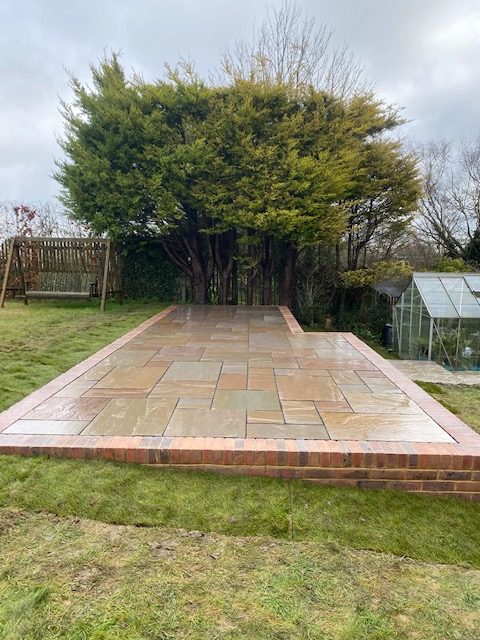
For a patio with timeless character, nothing quite compares to the look of natural stone. Unlike perfectly uniform concrete, every single slab of sandstone or slate is one-of-a-kind, with subtle shifts in colour and texture that only nature can create. This beautiful variation means your finished patio will have its own unique, earthy charm that feels like it’s always been a part of your garden. It’s a look that’s impossible to fully replicate.
Often sold as garden flags and listed as paving stones pavers in some catalogues, these slabs can create classic flagged patios that blend naturally into established landscapes.
However, that natural quality comes with a key consideration: porosity. Many natural stones, especially popular choices like sandstone, are highly absorbent. They can soak up spilled wine or moisture from fallen leaves, which can lead to stubborn stains. In colder climates, this absorbed water can freeze and expand, potentially causing the surface to flake or crack over time. This is why sealing natural stone pavers isn’t just a suggestion, it’s essential maintenance.
Beyond upkeep, the installation itself can be more challenging for a weekend DIY project. Because these slabs are cut from real rock, their thickness can vary from one piece to the next. A professional installer knows how to adjust for this to create a level surface, but it can be frustrating for a first-timer used to the consistency of concrete. It’s a solvable challenge, but one that requires a bit more patience and skill.


The Modern Workhorse: Why Everyone Is Talking About Porcelain Slabs
If the idea of sealing stone and scrubbing away stains sounds like a chore, then porcelain slabs are the modern solution you’ve been looking for. Remember how other materials can be porous? Porcelain is the exact opposite. It’s manufactured to be non-porous, like a ceramic plate, meaning spills from a barbecue or green moss simply can’t sink in. A quick wipe or spray with a hose is usually all it takes to make them look new again.
This non-porous quality delivers another huge advantage, especially in colder climates. Since water can’t penetrate the surface, there’s no risk of it freezing, expanding, and causing cracks over winter. This makes them fully frost-proof paving slabs, cementing their reputation as the ultimate choice for low-maintenance garden paving that stays pristine year after year with very little effort on your part.
So, what’s the trade-off for this amazing durability? That incredible density comes at a price. Porcelain is so hard that it’s difficult to cut, often requiring a professional with special diamond blades. This installation challenge, combined with a higher upfront material cost, makes it a premium investment. It’s the key difference to consider when comparing porcelain vs sandstone paving slabs.
How to Choose Your Winner: Match the Slab to Your Life
Feeling a bit overwhelmed? Don’t be. The best material for patio pavers is simply the one that best fits your life. Instead of getting lost in details, just ask yourself what truly matters most for your home and family. Answering that question is the secret to choosing patio slabs you’ll love for years.
To make it even easier, here’s a quick cheat sheet:
- Lowest Budget? Concrete is your most cost-effective friend for cheap paving slabs that still look good.
- Hate Cleaning? Porcelain is the undisputed low-maintenance champion.
- Love Natural Character? Natural Stone, if you’re happy to seal it.
- Kids & Pool Area? Prioritise non-slip patio slab options like textured porcelain or a high-grip natural stone.
If price is the priority, check local quotes: ask how much are paving slabs in your area, compare the cement slab price by thickness and finish, and estimate how much to slab a garden based on area and sub-base needs. This quick research can reveal genuinely cheap slabs or cheap pavement slabs that still meet your standards.
Ultimately, balancing cost, upkeep, and looks is a personal choice. Once you’ve settled on a material, the fun part begins: picking out the perfect size, colour, and pattern.
The Finishing Touch: Does Slab Size, Colour, and Pattern Matter?
With a clear understanding of the real-world differences between porcelain, stone, and concrete, you can confidently match a material to your lifestyle. You also know the simple design tricks, like using large slabs to make a space feel bigger or how a dark colour can affect heat.
When you choose sizes, think about pavement slab sizes such as classic 3×2 slabs, 400×400 paving slabs, or larger formats like the cheapest 600×600 paving slabs to reduce joints and speed laying. Thickness matters too: 50mm paving slabs add extra strength where you expect heavier use. For straightforward paths or utility areas, concrete pavement slabs or a single concrete slab paver can be a practical, low-fuss choice.
Your next step isn’t to buy a pallet of pavers. It’s much simpler. Grab a few samples of the materials that caught your eye. Place them in your garden and see how they look in the sun and after it rains. This simple, hands-on test will tell you more than any brochure ever could. Browse garden slab ideas for layout inspiration, then finalise colours and patterns that complement your space.
This project is about creating the stage for future memories. You have the knowledge to choose a foundation that’s perfect for everything from morning coffees to summer cookouts. Your ideal patio is now within reach.
If you are looking for inspiration check out our garden patio ideas
Explore Our Driveway Services: